
What is a barn conversion?
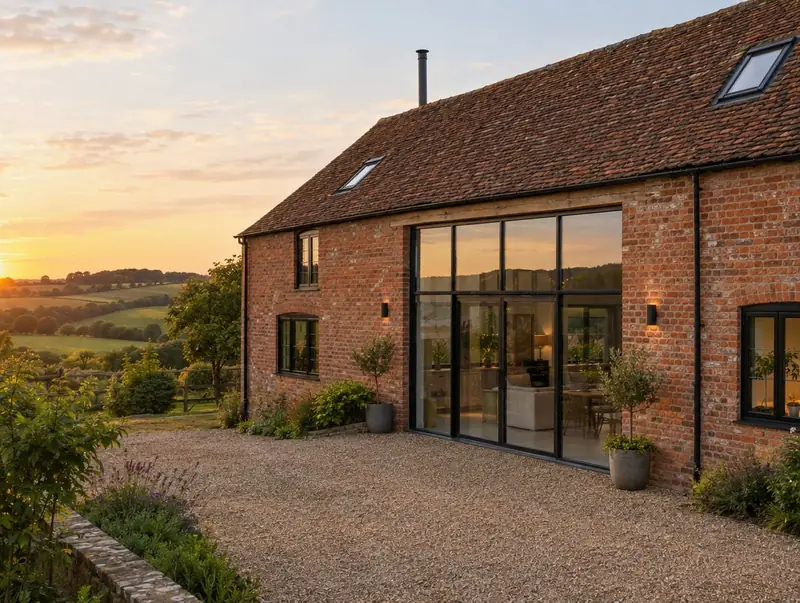
A barn conversion turns an agricultural or rural building into a home while keeping its character: the brick or stone walls, roof timbers and large openings. It involves structural repair, insulation, new services and often a new floor slab.
How much does a barn conversion cost in Cupar?
In Cupar, a barn conversion typically costs £1,750–£2,900 per m² of floor area, including VAT at usually 5% (reduced rate for creating a new dwelling). For a typical 150 m² project that is roughly £262,500–£435,000. Building costs in Scotland are close to the UK average, so the figures for Cupar are close to our national guide. Design, structural calculations and council fees are extra.
| Size or type | Guide range |
|---|---|
| Smaller project (105 m²) | £184,000–£304,500 |
| Typical project (150 m²) | £262,500–£435,000 |
| Larger project (210 m²) | £367,500–£609,000 |
| Rate per m² | £1,750–£2,900 |
Your quote will depend mainly on:
- Insulation approach
- Planning conditions and ecology
- Services and drainage
- Glazing and finishes
A guide range is only a starting point: the guide price tool gives an instant figure for your size, and a free survey turns it into a fixed quote.
Do you need planning permission for a barn conversion in Cupar?
The approval route for Cupar is set by planning law in Scotland. In Scotland converting a barn into a home usually needs planning permission (limited permitted development rights exist for some agricultural buildings), and a building warrant is needed.
In Scotland a building warrant is needed before work starts on most extensions, loft conversions and conversions. It is issued by the council’s building standards service. When the work is finished, a completion certificate is submitted and accepted by the council after inspection.
Our first visit includes a check of your planning history, so you know the route before paying for drawings.
What we handle
What we take care of:
- Planning or prior approval application
- New roof covering where needed
- Structural repairs and new floor slab
- Insulation that respects the existing fabric
- Ecology and bat survey coordination
- Services, drainage and septic or treatment plant
How long does it take?
Allow 6 to 12 months on site depending on condition. Before that, surveys, drawings and approvals usually take 4 to 9 months, longer if the council asks for changes.
Building in Cupar
In Scotland, bungalows and one-and-a-half-storey homes are common, so dormer conversions are a popular way to add bedrooms.
Cupar sits in Fife, about 10 miles north-east of Glenrothes. We cover the whole of Cupar, including postcodes KY15.
How it works
- 01
Visit and measured survey
A free visit to understand the project, check access and take measurements.
- 02
Design and pricing
Design options, then a fixed quote based on the chosen drawings and specification.
- 03
Approvals
Planning or permitted development confirmation, building regulations and any party wall matters.
- 04
Construction and completion
We build, put right any snags and hand over the building control certificate.
Questions about barn conversions in Cupar
Can I get a mortgage for a barn conversion?
Specialist self-build and conversion mortgages release money in stages. We can provide the staged costings lenders ask for.
Who approves a barn conversion in Cupar?
Planning matters in Cupar go to the council covering your address, and the work needs a building warrant. We prepare and submit the applications for you.
How much does a barn conversion cost in Cupar?
In Cupar, a barn conversion typically costs £1,750–£2,900 per m² of floor area, including VAT at usually 5% (reduced rate for creating a new dwelling). A typical 150 m² project comes to roughly £262,500–£435,000. Your fixed price depends on the survey and drawings.
Do I need planning permission for a barn conversion in Cupar?
In Scotland converting a barn into a home usually needs planning permission (limited permitted development rights exist for some agricultural buildings), and a building warrant is needed.
Is VAT reduced on a barn conversion?
Usually yes. Converting a non-residential building into a dwelling normally qualifies for the reduced 5% VAT rate on building work. Our guide prices assume this rate.
How long does a barn conversion take?
Typically 6 to 12 months on site, depending on the building’s condition.