
What is a barn conversion?
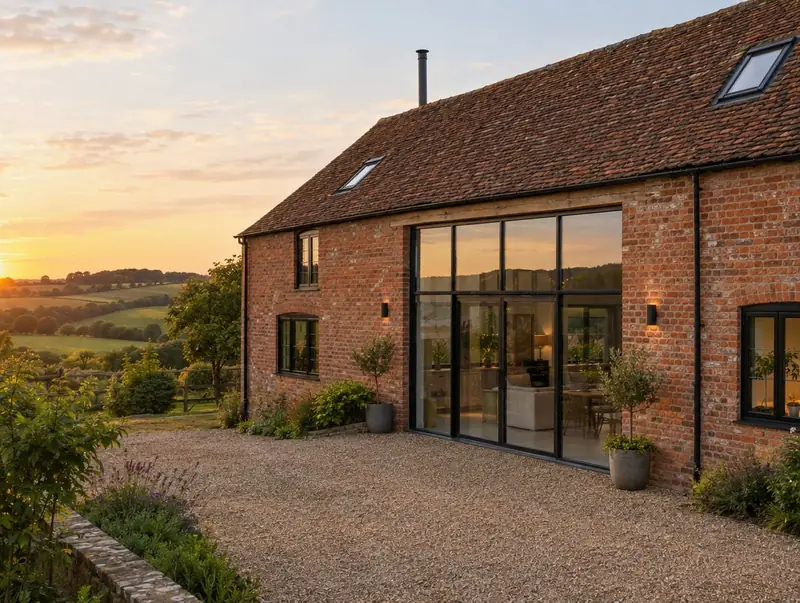
A barn conversion turns an agricultural or rural building into a home while keeping its character: the brick or stone walls, roof timbers and large openings. It involves structural repair, insulation, new services and often a new floor slab.
How much does a barn conversion cost in Paisley?
In Paisley, a barn conversion typically costs £1,750–£2,900 per m² of floor area, including VAT at usually 5% (reduced rate for creating a new dwelling). For a typical 150 m² project that is roughly £262,500–£435,000. Prices in Scotland sit near the national average for this kind of work, and the range for Paisley reflects that. Design, structural calculations and council fees are extra.
| Size or type | Guide range |
|---|---|
| Smaller project (105 m²) | £184,000–£304,500 |
| Typical project (150 m²) | £262,500–£435,000 |
| Larger project (210 m²) | £367,500–£609,000 |
| Rate per m² | £1,750–£2,900 |
What moves the price most:
- Access to the site
- Glazing and finishes
- Insulation approach
- Condition of the existing structure
For a figure based on your own measurements, try the guide price tool, then book a free home visit for a fixed quote.
Do you need planning permission for a barn conversion in Paisley?
The approval route for Paisley is set by planning law in Scotland. In Scotland converting a barn into a home usually needs planning permission (limited permitted development rights exist for some agricultural buildings), and a building warrant is needed.
In Scotland a building warrant is needed before work starts on most extensions, loft conversions and conversions. It is issued by the council’s building standards service. When the work is finished, a completion certificate is submitted and accepted by the council after inspection.
If the answer is not clear-cut, we can apply for formal confirmation before you commit to the build.
What we handle
From survey to sign-off, the job normally involves:
- Ecology and bat survey coordination
- Building control completion
- Structural repairs and new floor slab
- Services, drainage and septic or treatment plant
- New roof covering where needed
- Insulation that respects the existing fabric
How long does it take?
The build itself usually takes 6 to 12 months on site depending on condition. Design and approvals come first and typically take 4 to 9 months, depending on the approval route.
Building in Paisley
In Scotland, bungalows and one-and-a-half-storey homes are common, so dormer conversions are a popular way to add bedrooms.
Projects in Paisley (PA1 and PA2) are surveyed in person before we quote, so the price reflects your actual property.
How it works
- 01
Free visit
We look at the property, talk through what you want and measure up. There is no charge and no obligation.
- 02
Design and fixed quote
Drawings, structural calculations and an itemised, fixed price for the agreed specification.
- 03
Permissions sorted
Applications, building control and neighbour arrangements, all before the start date.
- 04
Build and handover
Work follows the agreed programme, with inspections along the way and a completion certificate at the end.
Questions about barn conversions in Paisley
How much does a barn conversion cost in Paisley?
In Paisley, a barn conversion typically costs £1,750–£2,900 per m² of floor area, including VAT at usually 5% (reduced rate for creating a new dwelling). A typical 150 m² project comes to roughly £262,500–£435,000. Your fixed price depends on the survey and drawings.
Is VAT reduced on a barn conversion?
Usually yes. Converting a non-residential building into a dwelling normally qualifies for the reduced 5% VAT rate on building work. Our guide prices assume this rate.
Do I need a bat survey?
Very often. Barns are common bat roosts, and planning authorities usually ask for an ecology survey.
How long does a barn conversion take in Paisley?
Typically 6 to 12 months on site depending on condition. Design and approvals beforehand usually take 4 to 9 months.
Do I need planning permission for a barn conversion in Paisley?
In Scotland converting a barn into a home usually needs planning permission (limited permitted development rights exist for some agricultural buildings), and a building warrant is needed.
What about drainage without mains sewer?
A sewage treatment plant can be installed, subject to the environmental regulator’s rules where you live.