
What is a basement conversion?
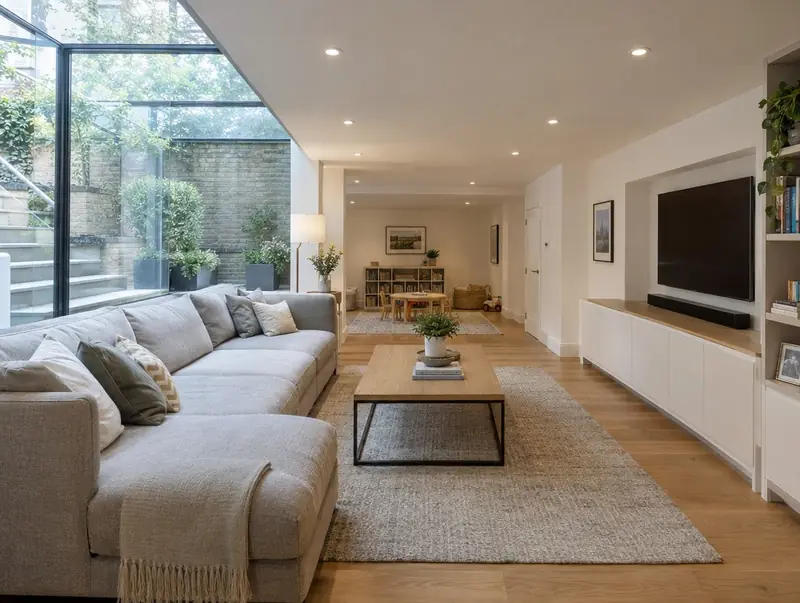
A basement conversion turns an existing cellar into living space, or excavates a new basement under the house or garden. Waterproofing, structural support and daylight are the main design challenges.
How much does a basement conversion cost in South Yorkshire?
In South Yorkshire, a basement conversion typically costs £1,750–£3,000 per m² for converting an existing cellar, including VAT at 20% (standard rate). For a typical 30 m² project that is roughly £52,500–£90,000. That range is adjusted for Yorkshire and the Humber, where domestic building work typically costs around 7% below the national average. Design, structural calculations and council fees are extra.
| Size or type | Guide range |
|---|---|
| Smaller project (21 m²) | £37,000–£63,000 |
| Typical project (30 m²) | £52,500–£90,000 |
| Larger project (42 m²) | £73,500–£126,000 |
| Rate per m² | £1,750–£3,000 |
The biggest cost drivers are:
- Party wall surveyor fees
- Waterproofing system
- Existing cellar or new excavation
- Ground water and access
A guide range is only a starting point: the guide price tool gives an instant figure for your size, and a free survey turns it into a fixed quote.
Do you need planning permission for a basement conversion in South Yorkshire?
The approval route for South Yorkshire is set by planning law in England. In England converting an existing cellar with no external change usually does not need planning permission. New excavation, lightwells and changes to the front often do, and some councils, particularly in London, have specific basement policies.
Building regulations approval comes from the council’s building control service or a registered building control approver. The work is inspected at key stages, such as foundations, drainage and insulation, and a completion certificate is issued at the end.
We check this for your address before design work starts, so there are no surprises later.
What we handle
The work we manage on a basement conversion:
- Structural and ground survey
- Electrics, heating and plastering
- Insulation, ventilation and drainage pumps
- Underpinning or new structure where needed
- Party wall notices
- Building control sign-off
How long does it take?
Build time is typically 8 to 16 weeks for a cellar conversion; longer for new excavation. Design and approvals come first and typically take 3 to 5 months, depending on the approval route.
Building in South Yorkshire
In Yorkshire, through-terraces and back-to-backs have particular constraints, while semis and detached houses suit larger extensions.
Towns we cover in South Yorkshire include Sheffield, Rotherham, Doncaster, Barnsley, Bentley and Chapeltown.
How it works
- 01
Visit and measured survey
A free visit to understand the project, check access and take measurements.
- 02
Drawings and written quote
We prepare the design and give you a written, itemised quote with inclusions and exclusions.
- 03
Permissions sorted
Applications, building control and neighbour arrangements, all before the start date.
- 04
Construction and completion
We build, put right any snags and hand over the building control certificate.
Questions about basement conversions in South Yorkshire
How much does a basement conversion cost in South Yorkshire?
In South Yorkshire, a basement conversion typically costs £1,750–£3,000 per m² for converting an existing cellar, including VAT at 20% (standard rate). A typical 30 m² project comes to roughly £52,500–£90,000. Your fixed price depends on the survey and drawings.
How long does a basement conversion take in South Yorkshire?
Typically 8 to 16 weeks for a cellar conversion; longer for new excavation. Design and approvals beforehand usually take 3 to 5 months.
How do you keep a basement dry?
With a waterproofing system designed to BS 8102, typically a cavity drain membrane with a sump pump, or a tanking system.
Does a basement conversion need planning permission?
Converting an existing cellar without changing the outside usually does not. New excavation, lightwells and changes visible from outside usually do.
Can a basement be a bedroom?
Yes, with a suitable escape route such as a lightwell window or protected stair.