
What is a dormer loft conversion?
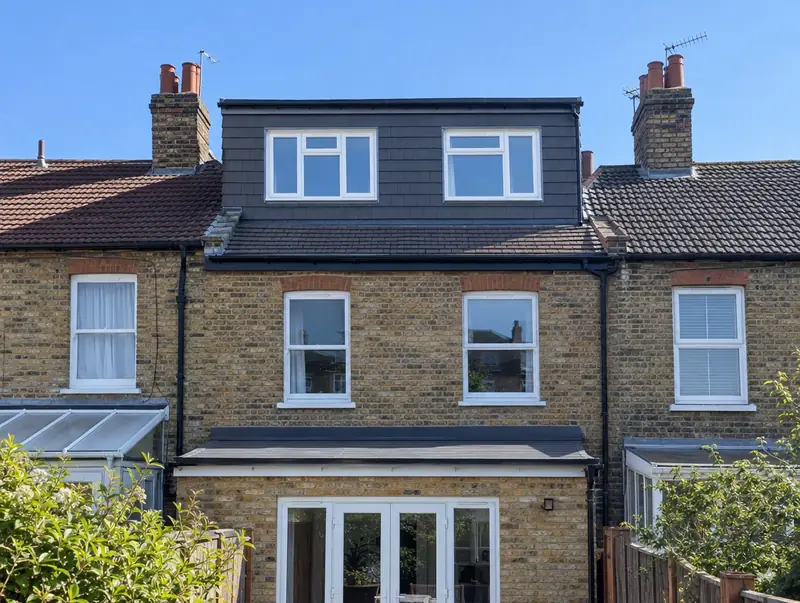
A dormer loft conversion adds a box-shaped structure to the rear roof slope, creating vertical walls and full headroom across most of the new room. It is the most common loft conversion in the UK because it works on terraced, semi-detached and detached houses.
How much does a dormer loft conversion cost in Devon?
In Devon, a dormer loft conversion typically costs £49,000–£69,500 for a typical rear dormer with en-suite, including VAT at 20% (standard rate). Prices in the South West sit near the national average for this kind of work, and the range for Devon reflects that. Design, structural calculations and council fees are extra.
| Size or type | Guide range |
|---|---|
| A typical rear dormer with en-suite | £49,000–£69,500 |
| Higher specification | £69,500–£87,000 |
The main things that change the cost:
- Dormer size and roof structure
- Scaffolding and access
- En-suite or bathroom
- Built-in storage and finishes
Your exact price depends on the survey and drawings. The guide price tool gives a quick range in the meantime.
Do you need planning permission for a dormer loft conversion in Devon?
The approval route for Devon is set by planning law in England. In England a rear dormer is often permitted development if the extra roof volume is no more than 40 cubic metres on a terraced house or 50 on other houses, it does not face the road, sits no higher than the ridge and is set back from the eaves, with matching materials and obscure-glazed side windows. Balconies, front dormers and work in conservation areas need planning permission.
Building regulations approval comes from the council’s building control service or a registered building control approver. The work is inspected at key stages, such as foundations, drainage and insulation, and a completion certificate is issued at the end.
Our first visit includes a check of your planning history, so you know the route before paying for drawings.
What we handle
What we take care of:
- Party wall notices for shared walls
- Measured survey and head-height check
- New staircase and fire-safe escape route
- Steel beams and new floor joists
- Drawings and structural calculations
- Building control completion certificate
How long does it take?
Build time is typically 6 to 9 weeks on site. Allow time beforehand for drawings and approvals, usually 6 to 12 weeks.
Building in Devon
In parts of the South West, protected landscapes and conservation areas shape what can be built, so materials and roof forms are chosen carefully.
Towns we cover in Devon include Plymouth, Exeter, Paignton, Torquay, Newton Abbot and Exmouth.
How it works
- 01
Visit and measured survey
A free visit to understand the project, check access and take measurements.
- 02
Design and pricing
Design options, then a fixed quote based on the chosen drawings and specification.
- 03
Permissions sorted
Applications, building control and neighbour arrangements, all before the start date.
- 04
Build and handover
Work follows the agreed programme, with inspections along the way and a completion certificate at the end.
Questions about dormer loft conversions in Devon
How much head height do I need?
Ideally at least 2.2 metres from the top of the ceiling joists to the underside of the ridge. Less can still work with a dormer, but we check this at the survey.
How much does a dormer loft conversion cost in Devon?
In Devon, a dormer loft conversion typically costs £49,000–£69,500 for a typical rear dormer with en-suite, including VAT at 20% (standard rate). Your fixed price depends on the survey and drawings.
Who approves a dormer loft conversion in Devon?
Planning matters in Devon go to the council covering your address, and the work needs building control approval. We prepare and submit the applications for you.
Do I need a party wall agreement?
In England and Wales, if the conversion cuts into or builds on a shared wall, notices must be served under the Party Wall etc. Act 1996.
Will I need to move out?
No. Most of the work is done from scaffolding and the roof. The new staircase is formed near the end, which causes a few days of disruption.