
What is a hip-to-gable loft conversion?
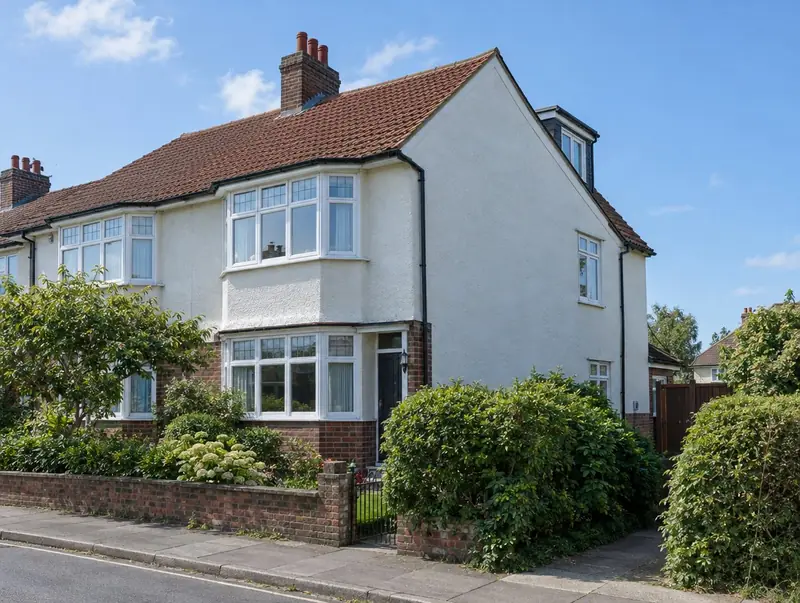
A hip-to-gable loft conversion replaces the sloping side (the hip) of a semi-detached or detached roof with a vertical gable wall. This extends the ridge and creates enough space for a staircase and a full-size room, usually combined with a rear dormer.
How much does a hip-to-gable loft conversion cost in Glasgow?
In Glasgow, a hip-to-gable loft conversion typically costs £53,500–£75,500 for a hip-to-gable with rear dormer, including VAT at 20% (standard rate). Building costs in Scotland are close to the UK average, so the figures for Glasgow are close to our national guide. Design, structural calculations and council fees are extra.
| Size or type | Guide range |
|---|---|
| A hip-to-gable with rear dormer | £53,500–£75,500 |
| Higher specification | £75,500–£94,500 |
The main things that change the cost:
- Gable wall construction and finish
- Staircase design
- Scaffolding to three sides
- Size of the rear dormer
A guide range is only a starting point: the guide price tool gives an instant figure for your size, and a free survey turns it into a fixed quote.
Do you need planning permission for a hip-to-gable loft conversion in Glasgow?
The approval route for Glasgow is set by planning law in Scotland. In Scotland changing a hipped roof to a gable often needs planning permission, because dormer and roof enlargement rights only apply well away from boundaries. A building warrant is needed before work starts.
In Scotland a building warrant is needed before work starts on most extensions, loft conversions and conversions. It is issued by the council’s building standards service. When the work is finished, a completion certificate is submitted and accepted by the council after inspection.
We check this for your address before design work starts, so there are no surprises later.
What we handle
The work we manage on a hip-to-gable loft conversion:
- Gable wall built in brick or block and finished to match
- Drawings and structural calculations
- Building control sign-off
- Steel beams and floor joists
- Roof extension and rear dormer
- Staircase and fire-safe escape route
How long does it take?
The build itself usually takes 7 to 10 weeks on site. Allow time beforehand for drawings and approvals, usually 6 to 12 weeks.
Building in Glasgow
In Scotland, bungalows and one-and-a-half-storey homes are common, so dormer conversions are a popular way to add bedrooms.
We cover the whole of Glasgow.
How it works
- 01
Survey and brief
We visit, discuss your ideas and budget, and survey the property or site at no cost.
- 02
Design and pricing
Design options, then a fixed quote based on the chosen drawings and specification.
- 03
Approvals in place
We handle planning, building control and neighbour notices before work starts.
- 04
Build and handover
Work follows the agreed programme, with inspections along the way and a completion certificate at the end.
Questions about hip-to-gable loft conversions in Glasgow
How much does a hip-to-gable loft conversion cost in Glasgow?
In Glasgow, a hip-to-gable loft conversion typically costs £53,500–£75,500 for a hip-to-gable with rear dormer, including VAT at 20% (standard rate). Your fixed price depends on the survey and drawings.
Do you build hip-to-gable loft conversions in Glasgow?
Yes. We build hip-to-gable loft conversions across Glasgow, including postcodes G1, G11, G12, G14 and G15. Every project starts with a free home visit.
How long does it take?
Typically 7 to 10 weeks on site.
Is a hip-to-gable better than a dormer?
On a hipped roof, a dormer alone often leaves too little space for stairs. Combining hip-to-gable with a rear dormer gives the most room.
Do I need planning permission for a hip-to-gable loft conversion in Glasgow?
In Scotland changing a hipped roof to a gable often needs planning permission, because dormer and roof enlargement rights only apply well away from boundaries. A building warrant is needed before work starts.
Will it look strange next to my neighbour?
On a pair of semis the roofs will no longer match unless your neighbour does the same. Many streets already have several converted roofs.