
What is an orangery?
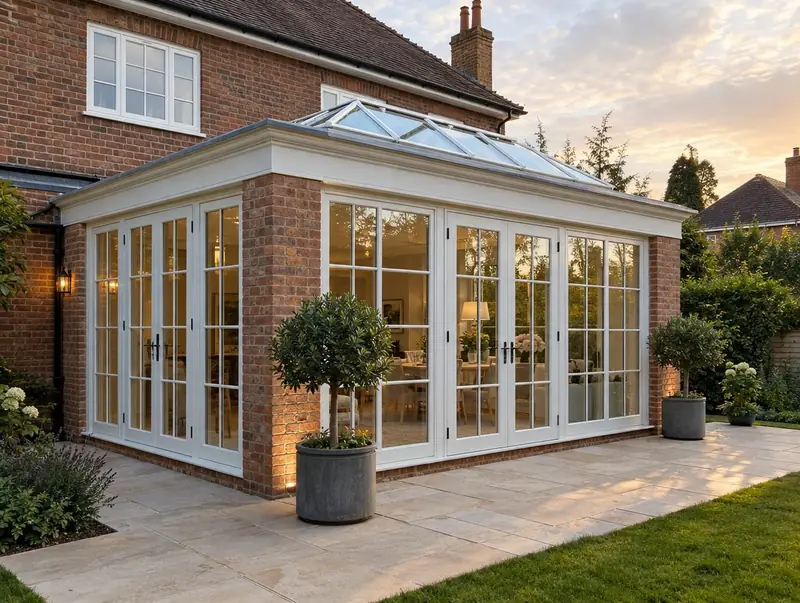
An orangery is an extension with brick or block piers, large areas of glazing and a solid perimeter roof around a central roof lantern. It sits between a conservatory and a traditional extension: brighter than an extension, warmer and more private than a conservatory.
How much does an orangery cost in Tooting?
In Tooting, an orangery typically costs £3,100–£4,400 per m² of floor area, including VAT at 20% (standard rate). For a typical 16 m² project that is roughly £49,500–£70,500. That range is adjusted for London, where domestic building work typically costs around 30% above the national average. Design, structural calculations and council fees are extra.
| Size or type | Guide range |
|---|---|
| Smaller project (11 m²) | £34,000–£48,500 |
| Typical project (16 m²) | £49,500–£70,500 |
| Larger project (22 m²) | £68,000–£97,000 |
| Rate per m² | £3,100–£4,400 |
What moves the price most:
- Lantern size
- Size and shape of the footprint
- Heating and flooring
- Opening into the house
Use the guide price tool to see how size and specification change the figure, then ask for a written, itemised quote.
Do you need planning permission for an orangery in Tooting?
Whether you need planning permission depends on your house and its location in England. In England a single-storey rear extension is often permitted development: broadly up to 3 metres deep on a semi-detached or terraced house and 4 metres on a detached house, no higher than 4 metres, with eaves no higher than 3 metres within 2 metres of a boundary, and covering no more than half the garden. The larger home extension scheme allows up to 6 or 8 metres if you notify the council first and neighbours have a chance to comment. In conservation areas, National Parks and National Landscapes the larger home extension route, side extensions and cladding are not permitted development. Flats and houses whose rights have been removed need a planning application, and listed buildings need listed building consent.
Where work involves a shared wall, building on the boundary, or digging foundations within 3 metres of a neighbour’s building and deeper than its foundations (or within 6 metres for deeper work), the Party Wall etc. Act 1996 applies and notices must be served before work starts.
Our first visit includes a check of your planning history, so you know the route before paying for drawings.
What we handle
Handled as part of most orangeries:
- Insulated perimeter roof with internal pelmet
- Building control sign-off where required
- Flooring and decoration options
- Roof lantern and glazed panels
- French, sliding or bifold doors
- Foundations and dwarf walls or piers
How long does it take?
Build time is typically 8 to 12 weeks on site. Allow time beforehand for drawings and approvals, usually 6 to 12 weeks.
Building in Tooting
Victorian and Edwardian terraces dominate many London streets, which is why side return, wraparound and mansard projects are so common here.
Tooting sits in Greater London, about 6 miles south of central London. We cover the whole of Tooting, including postcodes SW17 and SW19.
How it works
- 01
Free visit
We look at the property, talk through what you want and measure up. There is no charge and no obligation.
- 02
Drawings and written quote
We prepare the design and give you a written, itemised quote with inclusions and exclusions.
- 03
Permissions sorted
Applications, building control and neighbour arrangements, all before the start date.
- 04
Build and sign-off
We run the build to a written programme and hand over the completion certificate.
Questions about orangeries in Tooting
Who approves an orangery in Tooting?
Planning matters in Tooting go to the council covering your address, and the work needs building control approval. We prepare and submit the applications for you.
How long does it take?
Typically 8 to 12 weeks on site once approvals are in place.
Can it be used all year?
Yes. With an insulated roof, efficient glazing and heating, an orangery is comfortable all year.
What is the difference between an orangery and a conservatory?
An orangery has a solid roof around a central lantern and more brickwork, while a conservatory is mostly glazed. Orangeries are usually warmer in winter and cooler in summer.
How much does an orangery cost in Tooting?
In Tooting, an orangery typically costs £3,100–£4,400 per m² of floor area, including VAT at 20% (standard rate). A typical 16 m² project comes to roughly £49,500–£70,500. Your fixed price depends on the survey and drawings.