
What is a planning or building regulations application?
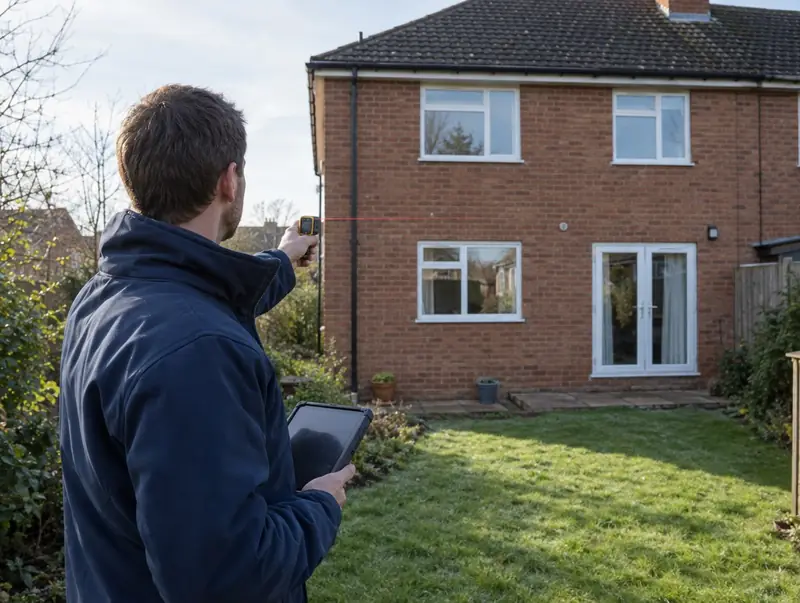
Planning permission decides whether a project can be built; building regulations decide how it must be built. Most extensions, lofts and conversions need building regulations approval even when planning permission is not required.
How much does a planning or building regulations application cost in Rugby?
In Rugby, a planning or building regulations application typically costs £750–£2,500 for application management (council fees extra), including VAT at 20% (standard rate; planning application fees carry no VAT, council building control fees include VAT). Prices in the West Midlands sit near the national average for this kind of work, and the range for Rugby reflects that. Council application fees are extra.
| Size or type | Guide range |
|---|---|
| Application management (council fees extra) | £750–£2,500 |
| Larger or more complex projects | £2,500–£3,000 |
Your quote will depend mainly on:
- Planning conditions
- Building control route
- Council fees
- Party wall surveyor appointments
Your exact price depends on the survey and drawings. The guide price tool gives a quick range in the meantime.
Planning and building regulations in Rugby
Whether you need planning permission depends on your house and its location in England. In England householder applications, lawful development certificates and prior approvals for larger home extensions go to the local planning authority. Building control can be the council or a registered building control approver.
Where work involves a shared wall, building on the boundary, or digging foundations within 3 metres of a neighbour’s building and deeper than its foundations (or within 6 metres for deeper work), the Party Wall etc. Act 1996 applies and notices must be served before work starts.
At the survey we check your house’s planning history and any restrictions, and tell you which route applies.
What we handle
Handled as part of most planning and building regulations applications:
- Planning or householder applications
- Prior approval (larger home extension) in England
- Build-over agreements with the water company
- Party wall notices
- Permitted development assessment
- Discharge of planning conditions
How long does it take?
Allow about 8 weeks for a householder planning decision (two months in Scotland). If the drawings are for a planning application, add the council’s decision period once they are submitted.
Building in Rugby
The West Midlands has large numbers of 1930s semis and Victorian terraces, which suit rear extensions, side extensions and dormer loft conversions.
Projects in Rugby (CV21) are surveyed in person before we quote, so the price reflects your actual property.
How it works
- 01
Survey and brief
We visit, talk through what you want and record the existing building.
- 02
Concept design
Options for layout and appearance, revised until you are happy.
- 03
Drawings and documents
The drawings and forms the council and building control need.
- 04
Approval
We follow the application through to a decision and pass on the approved drawings.
Questions about planning and building regulations applications in Rugby
What happens if I build without approval?
The council can take enforcement action, and missing approvals cause problems when selling. It is always better to get approvals first.
How much does a planning or building regulations application cost in Rugby?
In Rugby, a planning or building regulations application typically costs £750–£2,500 for application management (council fees extra), including VAT at 20% (standard rate; planning application fees carry no VAT, council building control fees include VAT). Your fixed price depends on the survey and drawings.
How long does a planning decision take?
Councils aim to decide most householder applications within 8 weeks.
Do you handle planning and building regulations applications in Rugby?
Yes. We handle planning and building regulations applications across Rugby, including postcodes CV21. Every project starts with a free home visit.
Who carries out building control?
Either the council’s building control service or, in England and Wales, a private building control body registered to do the work. In Scotland and Northern Ireland building control is provided by the council.