
What is a side return extension?
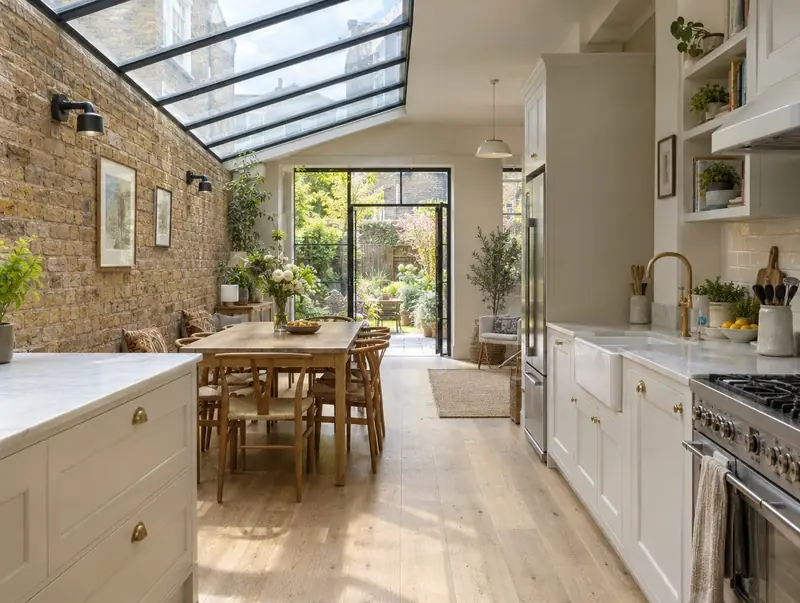
A side return extension fills the narrow passage that runs alongside the back addition of many Victorian and Edwardian terraced houses. It widens a galley kitchen into a proper kitchen-diner, usually with a sloping glazed roof to keep the room bright.
How much does a side return extension cost in Gloucester?
In Gloucester, a side return extension typically costs £2,350–£3,350 per m² of floor area, including VAT at 20% (standard rate). For a typical 12 m² project that is roughly £28,000–£40,000. Prices in the South West sit near the national average for this kind of work, and the range for Gloucester reflects that. Design, structural calculations and council fees are extra.
| Size or type | Guide range |
|---|---|
| Smaller project (8 m²) | £19,000–£27,000 |
| Typical project (12 m²) | £28,000–£40,000 |
| Larger project (17 m²) | £40,000–£57,000 |
| Rate per m² | £2,350–£3,350 |
The main things that change the cost:
- Steel beams and propping of the back addition
- Access through the house for materials
- Glazed roof specification
- Moving drains and soil stacks
For a figure based on your own measurements, try the guide price tool, then book a free home visit for a fixed quote.
Do you need planning permission for a side return extension in Gloucester?
Whether you need planning permission depends on your house and its location in England. In England a side return infill is treated as a side extension. It may be permitted development if it is single-storey, no more than 4 metres high and no wider than half the original house, but not in a conservation area. Because side returns sit on the boundary, party wall notices are almost always needed.
Where work involves a shared wall, building on the boundary, or digging foundations within 3 metres of a neighbour’s building and deeper than its foundations (or within 6 metres for deeper work), the Party Wall etc. Act 1996 applies and notices must be served before work starts.
Our first visit includes a check of your planning history, so you know the route before paying for drawings.
What we handle
On a typical side return extension we handle:
- Party wall advice and notices
- Building control sign-off
- Drawings and planning or permitted development check
- Floor levelling, heating and electrics
- Foundations and drainage, including any build-over agreement
- Glazed or solid roof with insulation
How long does it take?
Build time is typically 10 to 14 weeks on site. Before that, surveys, drawings and approvals usually take 3 to 4 months, longer if the council asks for changes.
Building in Gloucester
The South West mixes stone and render cottages with post-war and newer estates, and local materials matter more here when matching an extension.
Our Gloucester coverage includes postcode districts GL1, and we also work in nearby places such as Cheltenham, Stroud and Tewkesbury.
How it works
- 01
Visit and measured survey
A free visit to understand the project, check access and take measurements.
- 02
Drawings and written quote
We prepare the design and give you a written, itemised quote with inclusions and exclusions.
- 03
Approvals
Planning or permitted development confirmation, building regulations and any party wall matters.
- 04
Construction and completion
We build, put right any snags and hand over the building control certificate.
Questions about side return extensions in Gloucester
Do you build side return extensions in Gloucester?
Yes. We build side return extensions across Gloucester, including postcodes GL1. Every project starts with a free home visit.
How much does a side return extension cost in Gloucester?
In Gloucester, a side return extension typically costs £2,350–£3,350 per m² of floor area, including VAT at 20% (standard rate). A typical 12 m² project comes to roughly £28,000–£40,000. Your fixed price depends on the survey and drawings.
How do you get materials in?
Mid-terrace houses often have no rear access, so materials come through the house. We protect floors and plan deliveries carefully.
Is a glass roof too hot or cold?
Modern solar-control double or triple glazing reduces glare and heat loss. Building regulations also limit how much glazing you can have unless the design shows it performs well enough.
Will I need a party wall agreement?
Almost certainly in England and Wales, because side returns sit on or near the boundary. Notices must be served before work starts, and a party wall surveyor may be appointed if the neighbour does not consent.