
What is a barn conversion?
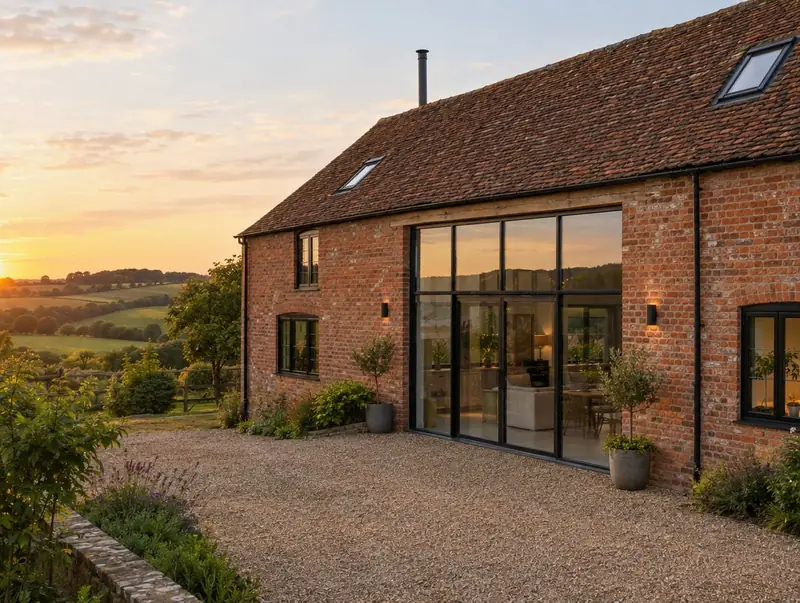
A barn conversion turns an agricultural or rural building into a home while keeping its character: the brick or stone walls, roof timbers and large openings. It involves structural repair, insulation, new services and often a new floor slab.
How much does a barn conversion cost in Ellesmere Port Town?
In Ellesmere Port Town, a barn conversion typically costs £1,700–£2,800 per m² of floor area, including VAT at usually 5% (reduced rate for creating a new dwelling). For a typical 150 m² project that is roughly £255,000–£420,000. Prices across the North West are typically 6% below the UK average for this kind of work, which is reflected in the range for Ellesmere Port Town. Design, structural calculations and council fees are extra.
| Size or type | Guide range |
|---|---|
| Smaller project (105 m²) | £178,500–£294,000 |
| Typical project (150 m²) | £255,000–£420,000 |
| Larger project (210 m²) | £357,000–£588,000 |
| Rate per m² | £1,700–£2,800 |
Your quote will depend mainly on:
- Glazing and finishes
- Access to the site
- Planning conditions and ecology
- Services and drainage
Your exact price depends on the survey and drawings. The guide price tool gives a quick range in the meantime.
Do you need planning permission for a barn conversion in Ellesmere Port Town?
Here is how the rules work for a barn conversion in England. In England converting an agricultural building into a home needs either full planning permission or prior approval under Class Q of the permitted development rules, which limits floor space and the number of homes. Listed barns also need listed building consent.
Building regulations approval comes from the council’s building control service or a registered building control approver. The work is inspected at key stages, such as foundations, drainage and insulation, and a completion certificate is issued at the end.
If the answer is not clear-cut, we can apply for formal confirmation before you commit to the build.
What we handle
Handled as part of most barn conversions:
- Insulation that respects the existing fabric
- Structural survey and feasibility
- Ecology and bat survey coordination
- Planning or prior approval application
- New roof covering where needed
- Services, drainage and septic or treatment plant
How long does it take?
Expect 6 to 12 months on site depending on condition. Allow time beforehand for drawings and approvals, usually 4 to 9 months.
Building in Ellesmere Port Town
Terraced streets across the North West often suit rear dormers and single-storey kitchen extensions.
From CH2 outwards, we take on projects throughout Ellesmere Port Town and the surrounding parts of Cheshire.
How it works
- 01
Visit and measured survey
A free visit to understand the project, check access and take measurements.
- 02
Design and pricing
Design options, then a fixed quote based on the chosen drawings and specification.
- 03
Approvals in place
We handle planning, building control and neighbour notices before work starts.
- 04
Build and handover
Work follows the agreed programme, with inspections along the way and a completion certificate at the end.
Questions about barn conversions in Ellesmere Port Town
How long does a barn conversion take?
Typically 6 to 12 months on site, depending on the building’s condition.
Do you build barn conversions in Ellesmere Port Town?
Yes. We build barn conversions across Ellesmere Port Town, including postcodes CH2 and CH65. Every project starts with a free home visit.
Can I get a mortgage for a barn conversion?
Specialist self-build and conversion mortgages release money in stages. We can provide the staged costings lenders ask for.
How much does a barn conversion cost in Ellesmere Port Town?
In Ellesmere Port Town, a barn conversion typically costs £1,700–£2,800 per m² of floor area, including VAT at usually 5% (reduced rate for creating a new dwelling). A typical 150 m² project comes to roughly £255,000–£420,000. Your fixed price depends on the survey and drawings.
Do I need a bat survey?
Very often. Barns are common bat roosts, and planning authorities usually ask for an ecology survey.