
What is a barn conversion?
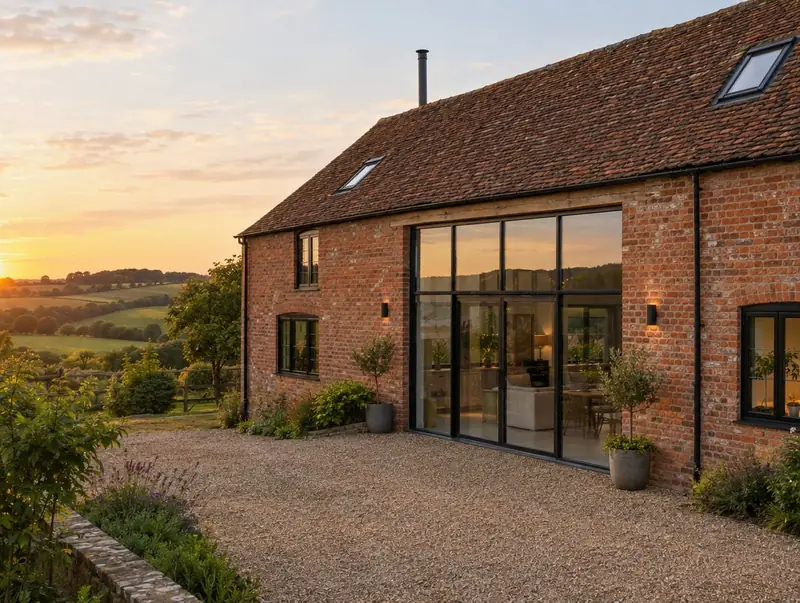
A barn conversion turns an agricultural or rural building into a home while keeping its character: the brick or stone walls, roof timbers and large openings. It involves structural repair, insulation, new services and often a new floor slab.
How much does a barn conversion cost in the Scottish Borders?
In the Scottish Borders, a barn conversion typically costs £1,750–£2,900 per m² of floor area, including VAT at usually 5% (reduced rate for creating a new dwelling). For a typical 150 m² project that is roughly £262,500–£435,000. Building costs in Scotland are close to the UK average, so the figures for the Scottish Borders are close to our national guide. Design, structural calculations and council fees are extra.
| Size or type | Guide range |
|---|---|
| Smaller project (105 m²) | £184,000–£304,500 |
| Typical project (150 m²) | £262,500–£435,000 |
| Larger project (210 m²) | £367,500–£609,000 |
| Rate per m² | £1,750–£2,900 |
The biggest cost drivers are:
- Condition of the existing structure
- Services and drainage
- Planning conditions and ecology
- Insulation approach
For a figure based on your own measurements, try the guide price tool, then book a free home visit for a fixed quote.
Do you need planning permission for a barn conversion in the Scottish Borders?
Whether you need planning permission depends on your house and its location in Scotland. In Scotland converting a barn into a home usually needs planning permission (limited permitted development rights exist for some agricultural buildings), and a building warrant is needed.
In Scotland a building warrant is needed before work starts on most extensions, loft conversions and conversions. It is issued by the council’s building standards service. When the work is finished, a completion certificate is submitted and accepted by the council after inspection.
We check this for your address before design work starts, so there are no surprises later.
What we handle
From survey to sign-off, the job normally involves:
- Planning or prior approval application
- Structural repairs and new floor slab
- Ecology and bat survey coordination
- Services, drainage and septic or treatment plant
- New roof covering where needed
- Structural survey and feasibility
How long does it take?
The build itself usually takes 6 to 12 months on site depending on condition. Allow time beforehand for drawings and approvals, usually 4 to 9 months.
Building in the Scottish Borders
In Scotland, bungalows and one-and-a-half-storey homes are common, so dormer conversions are a popular way to add bedrooms.
Towns we cover in the Scottish Borders include Hawick, Galashiels, Peebles, Kelso and Selkirk.
How it works
- 01
Visit and measured survey
A free visit to understand the project, check access and take measurements.
- 02
Design and fixed quote
Drawings, structural calculations and an itemised, fixed price for the agreed specification.
- 03
Approvals
Planning or permitted development confirmation, building regulations and any party wall matters.
- 04
Build and sign-off
We run the build to a written programme and hand over the completion certificate.
Questions about barn conversions in the Scottish Borders
Who approves a barn conversion in the Scottish Borders?
Planning matters in the Scottish Borders go to the council covering your address, and the work needs a building warrant. We prepare and submit the applications for you.
Can I get a mortgage for a barn conversion?
Specialist self-build and conversion mortgages release money in stages. We can provide the staged costings lenders ask for.
How much does a barn conversion cost in the Scottish Borders?
In the Scottish Borders, a barn conversion typically costs £1,750–£2,900 per m² of floor area, including VAT at usually 5% (reduced rate for creating a new dwelling). A typical 150 m² project comes to roughly £262,500–£435,000. Your fixed price depends on the survey and drawings.
Do I need planning permission for a barn conversion in the Scottish Borders?
In Scotland converting a barn into a home usually needs planning permission (limited permitted development rights exist for some agricultural buildings), and a building warrant is needed.
Is VAT reduced on a barn conversion?
Usually yes. Converting a non-residential building into a dwelling normally qualifies for the reduced 5% VAT rate on building work. Our guide prices assume this rate.
What about drainage without mains sewer?
A sewage treatment plant can be installed, subject to the environmental regulator’s rules where you live.