
What is a basement conversion?
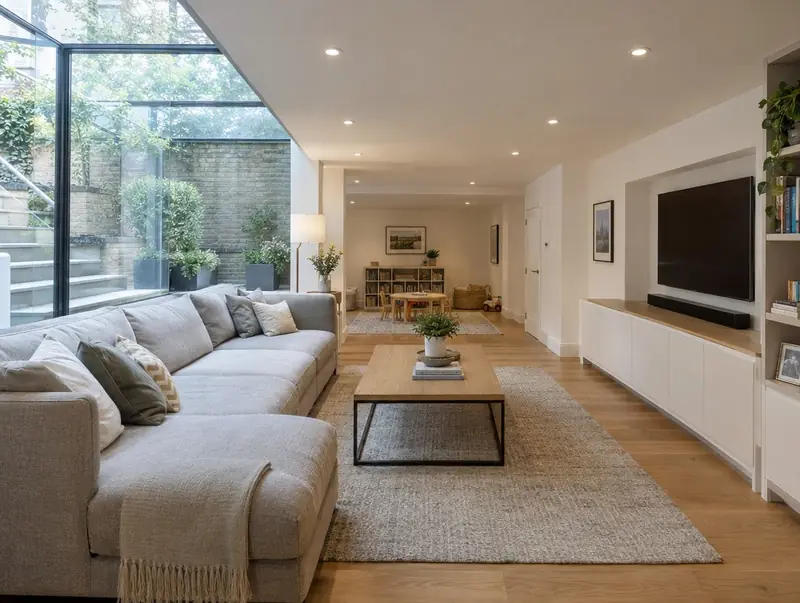
A basement conversion turns an existing cellar into living space, or excavates a new basement under the house or garden. Waterproofing, structural support and daylight are the main design challenges.
How much does a basement conversion cost in Burnley?
In Burnley, a basement conversion typically costs £1,800–£3,000 per m² for converting an existing cellar, including VAT at 20% (standard rate). For a typical 30 m² project that is roughly £54,000–£90,000. That range is adjusted for the North West, where domestic building work typically costs around 6% below the national average. Design, structural calculations and council fees are extra.
| Size or type | Guide range |
|---|---|
| Smaller project (21 m²) | £38,000–£63,000 |
| Typical project (30 m²) | £54,000–£90,000 |
| Larger project (42 m²) | £75,500–£126,000 |
| Rate per m² | £1,800–£3,000 |
Your quote will depend mainly on:
- Floor lowering and underpinning
- Party wall surveyor fees
- Waterproofing system
- Existing cellar or new excavation
Use the guide price tool to see how size and specification change the figure, then ask for a written, itemised quote.
Do you need planning permission for a basement conversion in Burnley?
Before anything is built in Burnley, we confirm which approvals apply in England. In England converting an existing cellar with no external change usually does not need planning permission. New excavation, lightwells and changes to the front often do, and some councils, particularly in London, have specific basement policies.
Where work involves a shared wall, building on the boundary, or digging foundations within 3 metres of a neighbour’s building and deeper than its foundations (or within 6 metres for deeper work), the Party Wall etc. Act 1996 applies and notices must be served before work starts.
If the answer is not clear-cut, we can apply for formal confirmation before you commit to the build.
What we handle
What we take care of:
- Lightwells and windows
- Underpinning or new structure where needed
- Structural and ground survey
- Building control sign-off
- Electrics, heating and plastering
- Party wall notices
How long does it take?
Build time is typically 8 to 16 weeks for a cellar conversion; longer for new excavation. Before that, surveys, drawings and approvals usually take 3 to 5 months, longer if the council asks for changes.
Building in Burnley
The North West has many brick terraces and inter-war semis, where kitchen extensions and dormer loft conversions add space without moving.
We work across Burnley and neighbouring areas such as Nelson, Colne and Accrington. Postcodes we cover in Burnley include BB11.
How it works
- 01
Survey and brief
We visit, discuss your ideas and budget, and survey the property or site at no cost.
- 02
Design and fixed quote
Drawings, structural calculations and an itemised, fixed price for the agreed specification.
- 03
Approvals
Planning or permitted development confirmation, building regulations and any party wall matters.
- 04
Build and handover
Work follows the agreed programme, with inspections along the way and a completion certificate at the end.
Questions about basement conversions in Burnley
How much does a basement conversion cost in Burnley?
In Burnley, a basement conversion typically costs £1,800–£3,000 per m² for converting an existing cellar, including VAT at 20% (standard rate). A typical 30 m² project comes to roughly £54,000–£90,000. Your fixed price depends on the survey and drawings.
Do I need party wall agreements?
In England and Wales, excavating near a neighbour’s foundations usually triggers the Party Wall etc. Act 1996.
Is new excavation worth it?
It can be in high-value areas, but costs are high. We give a feasibility view before design starts.
How long does a basement conversion take in Burnley?
Typically 8 to 16 weeks for a cellar conversion; longer for new excavation. Design and approvals beforehand usually take 3 to 5 months.
Does a basement conversion need planning permission?
Converting an existing cellar without changing the outside usually does not. New excavation, lightwells and changes visible from outside usually do.