
What is a dormer loft conversion?
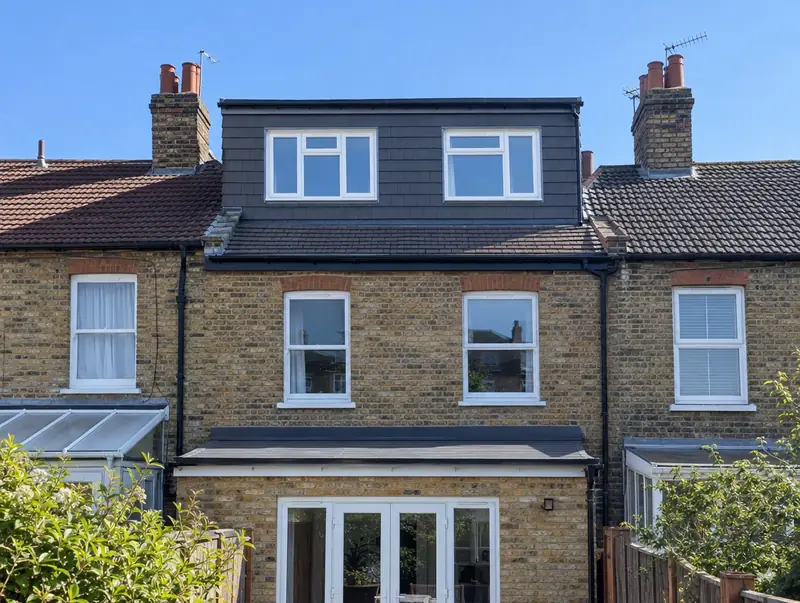
A dormer loft conversion adds a box-shaped structure to the rear roof slope, creating vertical walls and full headroom across most of the new room. It is the most common loft conversion in the UK because it works on terraced, semi-detached and detached houses.
How much does a dormer loft conversion cost in Gwent?
In Gwent, a dormer loft conversion typically costs £44,000–£62,500 for a typical rear dormer with en-suite, including VAT at 20% (standard rate). Prices across Wales are typically 8% below the UK average for this kind of work, which is reflected in the range for Gwent. Design, structural calculations and council fees are extra.
| Size or type | Guide range |
|---|---|
| A typical rear dormer with en-suite | £44,000–£62,500 |
| Higher specification | £62,500–£78,000 |
What moves the price most:
- Built-in storage and finishes
- Staircase position
- Dormer size and roof structure
- Scaffolding and access
Your exact price depends on the survey and drawings. The guide price tool gives a quick range in the meantime.
Do you need planning permission for a dormer loft conversion in Gwent?
The approval route for Gwent is set by planning law in Wales. In Wales roof enlargements such as rear dormers can be permitted development within volume limits and design conditions. Dormers facing a road, balconies and conservation-area work need permission.
The Party Wall etc. Act 1996 applies in Wales, so notices must be served before work on a shared wall, on the boundary, or excavation close to a neighbour’s foundations.
If the answer is not clear-cut, we can apply for formal confirmation before you commit to the build.
What we handle
On a typical dormer loft conversion we handle:
- Insulation, plastering, electrics and plumbing
- Party wall notices for shared walls
- New staircase and fire-safe escape route
- Drawings and structural calculations
- Dormer structure, roof covering and windows
- Steel beams and new floor joists
How long does it take?
The build itself usually takes 6 to 9 weeks on site. Design and approvals come first and typically take 6 to 12 weeks, depending on the approval route.
Building in Gwent
Wales has many terraced valley streets, stone cottages and post-war estates, so extension designs are shaped by slopes, materials and local character.
Towns we cover in Gwent include Newport, Cwmbran, Pontypool, Ebbw Vale, Risca and Abergavenny.
How it works
- 01
Survey and brief
We visit, discuss your ideas and budget, and survey the property or site at no cost.
- 02
Design and fixed quote
Drawings, structural calculations and an itemised, fixed price for the agreed specification.
- 03
Permissions sorted
Applications, building control and neighbour arrangements, all before the start date.
- 04
Build and handover
Work follows the agreed programme, with inspections along the way and a completion certificate at the end.
Questions about dormer loft conversions in Gwent
How much does a dormer loft conversion cost in Gwent?
In Gwent, a dormer loft conversion typically costs £44,000–£62,500 for a typical rear dormer with en-suite, including VAT at 20% (standard rate). Your fixed price depends on the survey and drawings.
How long does it take?
Usually 6 to 9 weeks on site.
What fire safety is required?
Building regulations require a safe escape route. Converting a two-storey house to three storeys usually means a protected stairway with fire doors to habitable rooms and mains-wired smoke alarms.
How much head height do I need?
Ideally at least 2.2 metres from the top of the ceiling joists to the underside of the ridge. Less can still work with a dormer, but we check this at the survey.
Do you build dormer loft conversions in Gwent?
Yes. We build dormer loft conversions across Gwent, including postcodes CF3, CF83, NP10, NP19 and NP20. Every project starts with a free home visit.
Do I need planning permission for a dormer loft conversion in Gwent?
In Wales roof enlargements such as rear dormers can be permitted development within volume limits and design conditions. Dormers facing a road, balconies and conservation-area work need permission.