
What is an orangery?
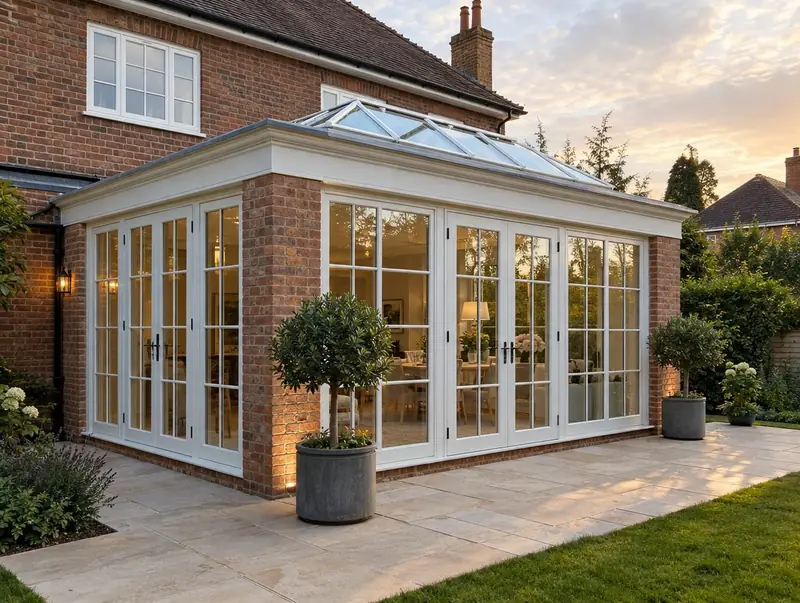
An orangery is an extension with brick or block piers, large areas of glazing and a solid perimeter roof around a central roof lantern. It sits between a conservatory and a traditional extension: brighter than an extension, warmer and more private than a conservatory.
How much does an orangery cost in East Sussex?
In East Sussex, an orangery typically costs £2,700–£3,800 per m² of floor area, including VAT at 20% (standard rate). For a typical 16 m² project that is roughly £43,000–£61,000. Building costs in the South East run about 12% above the UK average, and the figures for East Sussex are adjusted to reflect that. Design, structural calculations and council fees are extra.
| Size or type | Guide range |
|---|---|
| Smaller project (11 m²) | £29,500–£42,000 |
| Typical project (16 m²) | £43,000–£61,000 |
| Larger project (22 m²) | £59,500–£83,500 |
| Rate per m² | £2,700–£3,800 |
The main things that change the cost:
- Amount and type of glazing
- Heating and flooring
- Opening into the house
- Frame material and colour
For a figure based on your own measurements, try the guide price tool, then book a free home visit for a fixed quote.
Do you need planning permission for an orangery in East Sussex?
Here is how the rules work for an orangery in England. In England a single-storey rear extension is often permitted development: broadly up to 3 metres deep on a semi-detached or terraced house and 4 metres on a detached house, no higher than 4 metres, with eaves no higher than 3 metres within 2 metres of a boundary, and covering no more than half the garden. The larger home extension scheme allows up to 6 or 8 metres if you notify the council first and neighbours have a chance to comment. In conservation areas, National Parks and National Landscapes the larger home extension route, side extensions and cladding are not permitted development. Flats and houses whose rights have been removed need a planning application, and listed buildings need listed building consent.
Building regulations approval comes from the council’s building control service or a registered building control approver. The work is inspected at key stages, such as foundations, drainage and insulation, and a completion certificate is issued at the end.
If the answer is not clear-cut, we can apply for formal confirmation before you commit to the build.
What we handle
On a typical orangery we handle:
- Flooring and decoration options
- Electrics, heating and plastering
- Roof lantern and glazed panels
- Design to suit the style of the house
- French, sliding or bifold doors
- Insulated perimeter roof with internal pelmet
How long does it take?
Expect 8 to 12 weeks on site. Design and approvals come first and typically take 6 to 12 weeks, depending on the approval route.
Building in East Sussex
The South East has a broad mix of housing, from Victorian terraces in the towns to post-war semis and newer estates, so extension types vary street by street.
Towns we cover in East Sussex include Brighton, Eastbourne, Hastings, Hove, Bexhill-on-Sea and Hailsham.
How it works
- 01
Free visit
We look at the property, talk through what you want and measure up. There is no charge and no obligation.
- 02
Design and pricing
Design options, then a fixed quote based on the chosen drawings and specification.
- 03
Approvals
Planning or permitted development confirmation, building regulations and any party wall matters.
- 04
Build and sign-off
We run the build to a written programme and hand over the completion certificate.
Questions about orangeries in East Sussex
Who approves an orangery in East Sussex?
Planning matters in East Sussex go to the council covering your address, and the work needs building control approval. We prepare and submit the applications for you.
Can an orangery replace a conservatory?
Yes. We can remove an old conservatory and build an orangery on new or upgraded foundations.
How much does an orangery cost in East Sussex?
In East Sussex, an orangery typically costs £2,700–£3,800 per m² of floor area, including VAT at 20% (standard rate). A typical 16 m² project comes to roughly £43,000–£61,000. Your fixed price depends on the survey and drawings.
Can it be used all year?
Yes. With an insulated roof, efficient glazing and heating, an orangery is comfortable all year.
What is the difference between an orangery and a conservatory?
An orangery has a solid roof around a central lantern and more brickwork, while a conservatory is mostly glazed. Orangeries are usually warmer in winter and cooler in summer.