
What is a structural alteration?
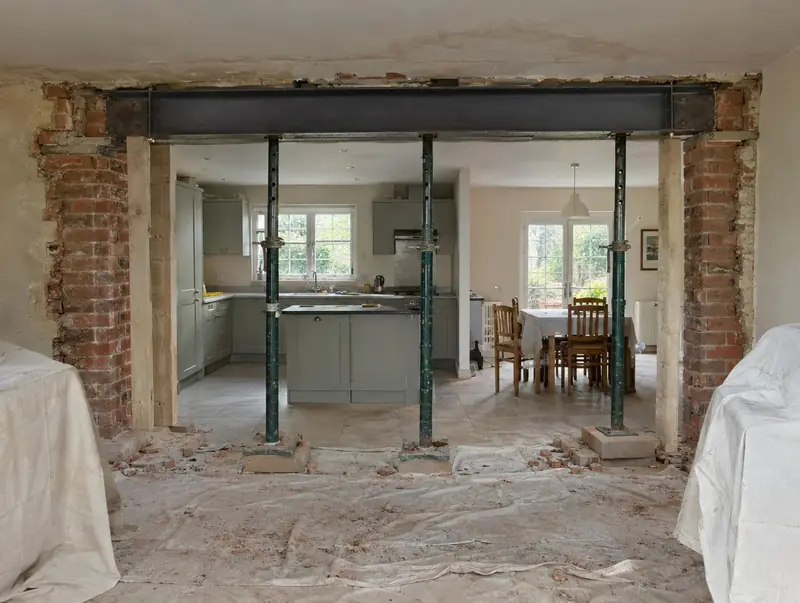
A structural alteration changes how a house carries its loads, most often by removing a load-bearing wall and replacing it with a steel beam. It is how kitchens and dining rooms become open-plan, and how extensions are joined to the original house.
How much does a structural alteration cost in the West Midlands?
In the West Midlands, a structural alteration typically costs £4,250–£9,250 for a typical knock-through with steel beam, including VAT at 20% (standard rate). Building costs in the West Midlands are close to the UK average, so the figures for the West Midlands are close to our national guide. Design, structural calculations and council fees are extra.
| Size or type | Guide range |
|---|---|
| A typical knock-through with steel beam | £4,250–£9,250 |
| Higher specification | £9,250–£11,500 |
What moves the price most:
- Span of the opening
- Party wall involvement
- Floor and ceiling repairs
- What sits above the wall
Use the guide price tool to see how size and specification change the figure, then ask for a written, itemised quote.
Do you need planning permission for a structural alteration in the West Midlands?
Whether you need planning permission depends on your house and its location in England. In England removing a load-bearing wall does not need planning permission but does need building regulations approval with an engineer’s calculations. If the beam bears on a party wall, a party wall notice must be served.
Where work involves a shared wall, building on the boundary, or digging foundations within 3 metres of a neighbour’s building and deeper than its foundations (or within 6 metres for deeper work), the Party Wall etc. Act 1996 applies and notices must be served before work starts.
We check this for your address before design work starts, so there are no surprises later.
What we handle
From survey to sign-off, the job normally involves:
- Fire protection to the steel
- Steel beam supply and installation on padstones
- Temporary propping
- Structural engineer’s calculations and drawings
- Making good, plastering and flooring repairs
- Party wall notices where needed
How long does it take?
Expect 1 to 2 weeks on site for a typical knock-through. Before that, surveys, drawings and approvals usually take 6 to 12 weeks, longer if the council asks for changes.
Building in the West Midlands
Across the West Midlands, inter-war and post-war semis make up much of the housing, giving good scope for two-storey side extensions and hip-to-gable lofts.
Towns we cover in the West Midlands include Birmingham, Coventry, Wolverhampton, Dudley, Walsall and Solihull.
How it works
- 01
Free visit
We look at the property, talk through what you want and measure up. There is no charge and no obligation.
- 02
Design and fixed quote
Drawings, structural calculations and an itemised, fixed price for the agreed specification.
- 03
Permissions sorted
Applications, building control and neighbour arrangements, all before the start date.
- 04
Build and handover
Work follows the agreed programme, with inspections along the way and a completion certificate at the end.
Questions about structural alterations in the West Midlands
Do I need building regulations approval?
Yes. Removing a load-bearing wall is building work that needs approval, with calculations for the beam.
How much does a structural alteration cost in the West Midlands?
In the West Midlands, a structural alteration typically costs £4,250–£9,250 for a typical knock-through with steel beam, including VAT at 20% (standard rate). Your fixed price depends on the survey and drawings.
Can the beam be hidden?
Often, by setting it within the ceiling depth. It depends on the joists and span.
How do I know if a wall is load-bearing?
Only a survey can confirm it. Walls that carry floor joists, roof loads or walls above are load-bearing. We check on site and the engineer confirms.
How long does a structural alteration take in the West Midlands?
Typically 1 to 2 weeks on site for a typical knock-through. Design and approvals beforehand usually take 6 to 12 weeks.