
What is a basement conversion?
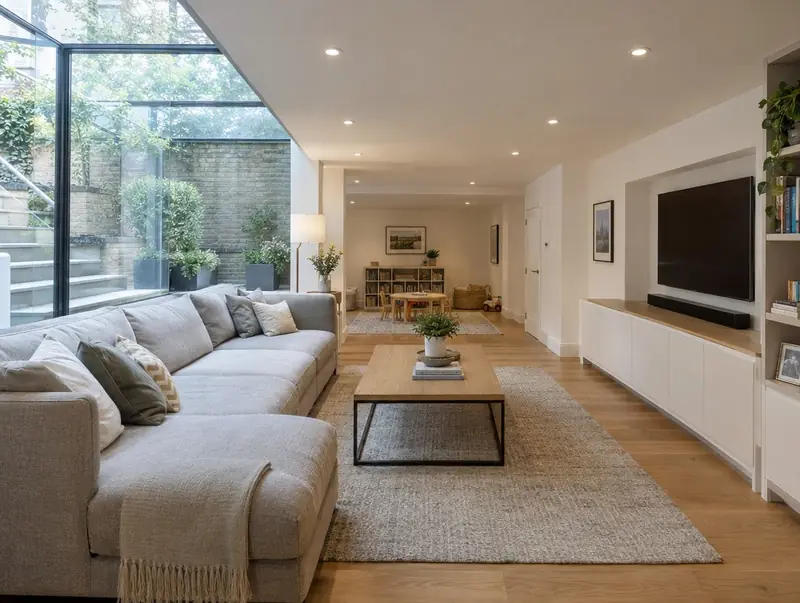
A basement conversion turns an existing cellar into living space, or excavates a new basement under the house or garden. Waterproofing, structural support and daylight are the main design challenges.
How much does a basement conversion cost in Banbridge?
In Banbridge, a basement conversion typically costs £1,650–£2,750 per m² for converting an existing cellar, including VAT at 20% (standard rate). For a typical 30 m² project that is roughly £49,500–£82,500. We start from a UK-wide guide and adjust it for Northern Ireland, where labour and materials are typically about 14% below average. Design, structural calculations and council fees are extra.
| Size or type | Guide range |
|---|---|
| Smaller project (21 m²) | £34,500–£58,000 |
| Typical project (30 m²) | £49,500–£82,500 |
| Larger project (42 m²) | £69,500–£115,500 |
| Rate per m² | £1,650–£2,750 |
Your quote will depend mainly on:
- Waterproofing system
- Existing cellar or new excavation
- Agreements with neighbours on shared walls
- Floor lowering and underpinning
A guide range is only a starting point: the guide price tool gives an instant figure for your size, and a free survey turns it into a fixed quote.
Do you need planning permission for a basement conversion in Banbridge?
The approval route for Banbridge is set by planning law in Northern Ireland. In Northern Ireland converting an existing cellar usually does not need planning permission; new excavation and external changes may.
Northern Ireland has no Party Wall Act. Work on shared walls relies on agreement with the neighbour and common law, so we agree the arrangements in writing before work starts.
Our first visit includes a check of your planning history, so you know the route before paying for drawings.
What we handle
Handled as part of most basement conversions:
- Electrics, heating and plastering
- Written agreement with neighbours on shared walls
- Building control sign-off
- Insulation, ventilation and drainage pumps
- Waterproofing design (tanking or cavity drain membrane)
- Underpinning or new structure where needed
How long does it take?
Expect 8 to 16 weeks for a cellar conversion; longer for new excavation. Allow time beforehand for drawings and approvals, usually 3 to 5 months.
Building in Banbridge
Northern Ireland has many detached and semi-detached homes on generous plots, which suits single-storey rear extensions and garage conversions.
Banbridge sits in County Down, about 12 miles north of Newry. We cover the whole of Banbridge, including postcodes BT32.
How it works
- 01
Visit and measured survey
A free visit to understand the project, check access and take measurements.
- 02
Design and pricing
Design options, then a fixed quote based on the chosen drawings and specification.
- 03
Approvals
Planning or permitted development confirmation, building regulations and any party wall matters.
- 04
Construction and completion
We build, put right any snags and hand over the building control certificate.
Questions about basement conversions in Banbridge
How do you keep a basement dry?
With a waterproofing system designed to BS 8102, typically a cavity drain membrane with a sump pump, or a tanking system.
Is new excavation worth it?
It can be in high-value areas, but costs are high. We give a feasibility view before design starts.
How long does it take?
A cellar conversion takes around 8 to 16 weeks; new basements take longer.
How much does a basement conversion cost in Banbridge?
In Banbridge, a basement conversion typically costs £1,650–£2,750 per m² for converting an existing cellar, including VAT at 20% (standard rate). A typical 30 m² project comes to roughly £49,500–£82,500. Your fixed price depends on the survey and drawings.
Do you build basement conversions in Banbridge?
Yes. We build basement conversions across Banbridge, including postcodes BT32. Every project starts with a free home visit.
Do I need planning permission for a basement conversion in Banbridge?
In Northern Ireland converting an existing cellar usually does not need planning permission; new excavation and external changes may.