
What is a basement conversion?
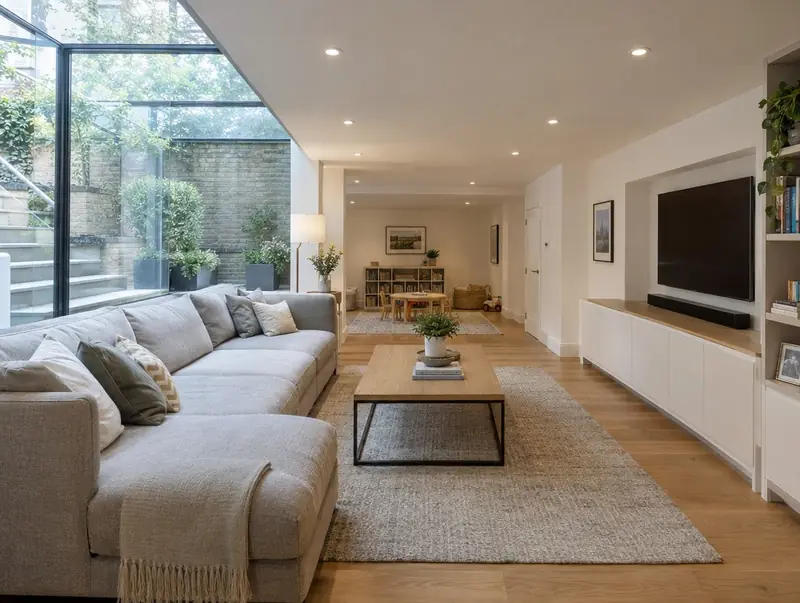
A basement conversion turns an existing cellar into living space, or excavates a new basement under the house or garden. Waterproofing, structural support and daylight are the main design challenges.
How much does a basement conversion cost in Thurso?
In Thurso, a basement conversion typically costs £1,850–£3,100 per m² for converting an existing cellar, including VAT at 20% (standard rate). For a typical 30 m² project that is roughly £55,500–£93,000. Island and remote projects usually cost more than this guide because of shipping, travel and accommodation. Design, structural calculations and council fees are extra.
| Size or type | Guide range |
|---|---|
| Smaller project (21 m²) | £39,000–£65,000 |
| Typical project (30 m²) | £55,500–£93,000 |
| Larger project (42 m²) | £77,500–£130,000 |
| Rate per m² | £1,850–£3,100 |
Your quote will depend mainly on:
- Lightwells
- Waterproofing system
- Ground water and access
- Existing cellar or new excavation
Use the guide price tool to see how size and specification change the figure, then ask for a written, itemised quote.
Do you need planning permission for a basement conversion in Thurso?
Whether you need planning permission depends on your house and its location in Scotland. In Scotland converting an existing cellar may not need planning permission, but a building warrant is needed, and new excavation usually needs planning permission.
Scotland has no Party Wall Act. Work on shared walls is governed by your title deeds, the Tenements (Scotland) Act 2004 for flats, and common law, so we agree arrangements with neighbours in writing before work starts.
Our first visit includes a check of your planning history, so you know the route before paying for drawings.
What we handle
From survey to sign-off, the job normally involves:
- Written agreement with neighbours on shared walls
- Structural and ground survey
- Electrics, heating and plastering
- Waterproofing design (tanking or cavity drain membrane)
- Lightwells and windows
- Building control sign-off
How long does it take?
Expect 8 to 16 weeks for a cellar conversion; longer for new excavation. Design and approvals come first and typically take 3 to 5 months, depending on the approval route.
Building in Thurso
In Scotland, bungalows and one-and-a-half-storey homes are common, so dormer conversions are a popular way to add bedrooms.
Because Thurso is a long way from the main centres, we confirm availability before quoting and list any travel costs separately.
How it works
- 01
Visit and measured survey
A free visit to understand the project, check access and take measurements.
- 02
Design and pricing
Design options, then a fixed quote based on the chosen drawings and specification.
- 03
Approvals in place
We handle planning, building control and neighbour notices before work starts.
- 04
Construction and completion
We build, put right any snags and hand over the building control certificate.
Questions about basement conversions in Thurso
How much does a basement conversion cost in Thurso?
In Thurso, a basement conversion typically costs £1,850–£3,100 per m² for converting an existing cellar, including VAT at 20% (standard rate). A typical 30 m² project comes to roughly £55,500–£93,000. Your fixed price depends on the survey and drawings.
Is new excavation worth it?
It can be in high-value areas, but costs are high. We give a feasibility view before design starts.
How do you keep a basement dry?
With a waterproofing system designed to BS 8102, typically a cavity drain membrane with a sump pump, or a tanking system.
Who approves a basement conversion in Thurso?
Planning matters in Thurso go to the council covering your address, and the work needs a building warrant. We prepare and submit the applications for you.
Can a basement be a bedroom?
Yes, with a suitable escape route such as a lightwell window or protected stair.
Do I need planning permission for a basement conversion in Thurso?
In Scotland converting an existing cellar may not need planning permission, but a building warrant is needed, and new excavation usually needs planning permission.